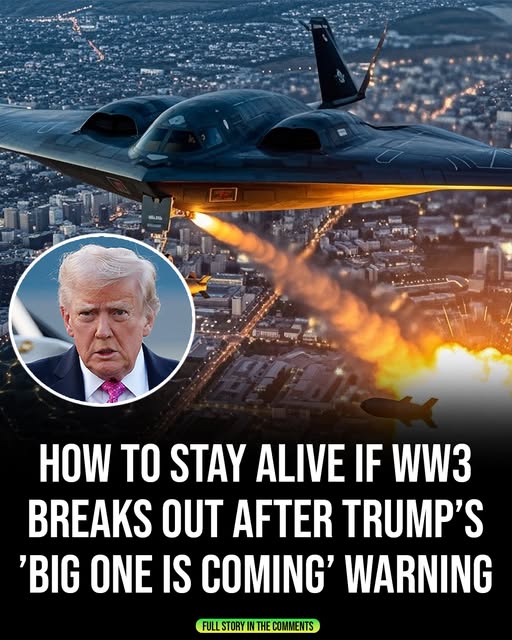
The geopolitical landscape has shifted from a state of uneasy tension to one of active, high-stakes military engagement. The joint U.S.-Israeli strikes that claimed the life of Iran’s Supreme Leader, Ayatollah Ali Khamenei, have sent a seismic shock through the international order. As Iran retaliates with drone and missile swarms targeting Western allies, the shadow of a third world war looms larger than at any point in the 21st century.
The rhetoric from the White House suggests that the current volatility is merely a prelude. “We haven’t even started hitting them hard. The big wave hasn’t even happened. The big one is coming soon,” President Trump told CNN earlier this week, signaling a potential for escalation that could dwarf current operations.
With the Middle East theater expanding, the ongoing war between Russia and Ukraine showing no signs of de-escalation, Pakistan’s recent strikes on Afghanistan, and the simmering friction between China and Taiwan, the world feels increasingly like a powder keg. This sentiment was echoed by Aleksandr Dugin—the ultranationalist philosopher frequently dubbed “Putin’s brain”—who recently declared with chilling finality: “World War 3 has already begun.”
In the face of such uncertainty, defense experts and government agencies are moving past diplomatic warnings and into the realm of civilian survivalism. While the goal remains the prevention of disaster, officials are now providing a clear roadmap for those seeking to maximize their survival odds should the unthinkable occur.
The “72-Hour” Standard: Crisis Management in the EU
Across Europe and North America, governments are urging a return to basic self-sufficiency. The European Union has pioneered the “72-hour method,” a strategy designed to bridge the gap between the onset of a catastrophe and the arrival of organized state relief.
EU Crisis Management Commissioner Hadja Lahbib recently emphasized that “Ready for anything must become our new European way of life.” The standard EU-recommended emergency kit focuses on mobility and core survival:
-
Sustenance: Non-perishable food and ample bottled water.
-
Utility: Torches with backup batteries, fire-starting tools, and a Swiss army knife or multi-tool.
-
Security & Health: Essential medications and important legal documents stored in waterproof casing.
-
Financial & Psychological: Hard cash (for when digital systems fail) and comfort items like playing cards to maintain morale during prolonged isolation.
Scandinavian Resilience: A Blueprint for Total Defense
The Nordic countries—historically the most prepared for regional instability—have taken preparedness a step further. Sweden, Finland, and Norway have recently updated and distributed official civil defense pamphlets to millions of households.
The Swedish government’s 32-page guide is particularly granular, offering specific instructions for conventional and nuclear scenarios. It advises citizens on “shielding” techniques, such as using heavy tape to seal windows and doors against radioactive dust, and the immediate preservation of water by filling bathtubs and sinks at the first sign of an alert.

Be First to Comment